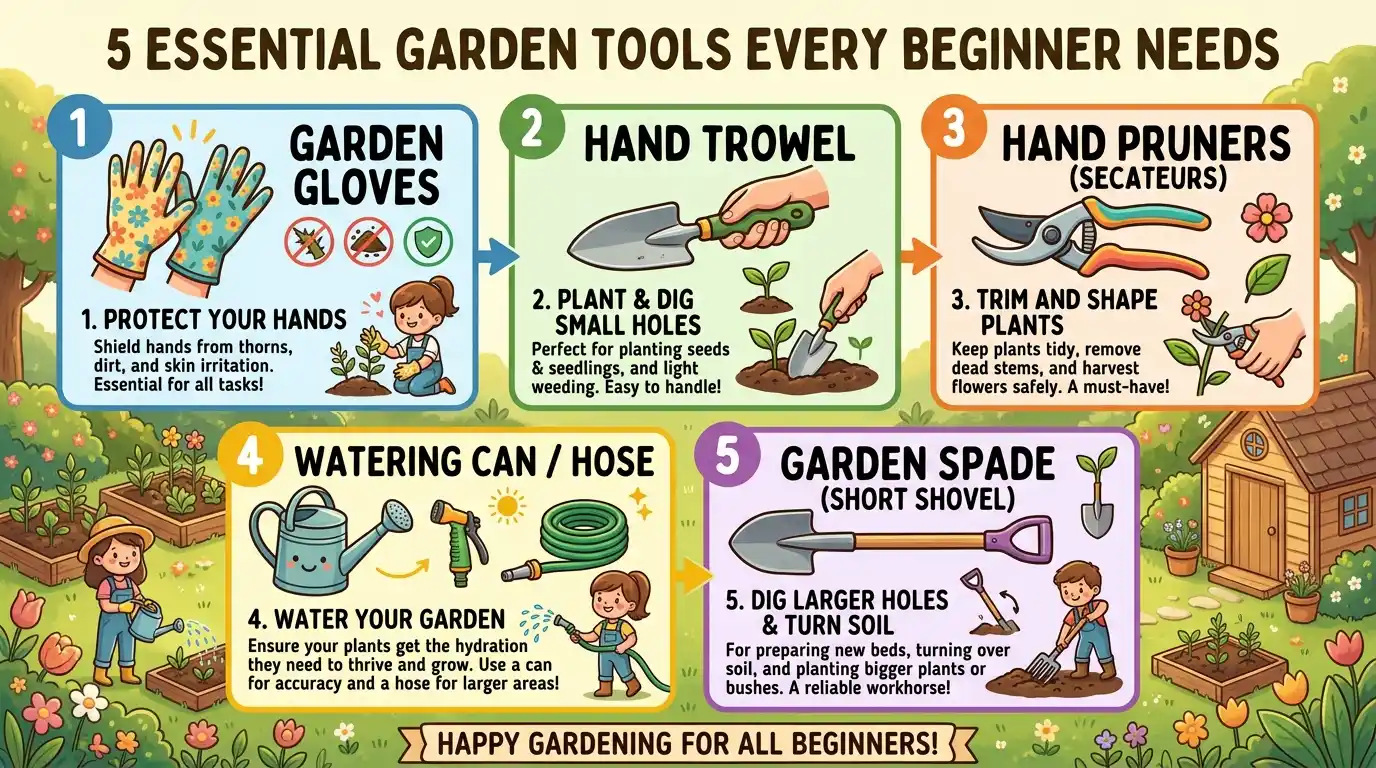
5 garden tools every beginner needs
Walk into any garden centre and you’ll find an entire wall of tools staring back at you. Forks, hoes, cultivators, dibbers, trowels in seventeen sizes. It’s overwhelming, and most of it you simply don’t need, especially when you’re just getting started.
The truth is, you can get through a whole first season with just five tools. Buy decent ones once, look after them, and they’ll last you years. Here’s what’s actually worth your money.
1. A hand trowel
If you only buy one tool, make it a hand trowel. You’ll use it for almost everything in a new garden bed: digging planting holes, moving small amounts of soil, lifting seedlings, and dealing with weeds that need to come out roots and all.
The cheap ones bend. If you’ve ever tried to plant anything in soil that’s slightly compacted and felt your trowel give way in your hand, you’ll know exactly what I mean. Spend a little more on one with a stainless steel head and a comfortable grip, and you’ll never need to replace it.
What to look for: Stainless steel blade, a comfortable handle (rubber grips are easier on the hands than wood), and depth markings on the blade to help you plant at the right depth without guessing.
2. A border fork
A border fork is a smaller version of a full-size garden fork, and it’s the one most beginners find easiest to use. You’ll reach for it every time you need to loosen soil before planting, work compost into a bed, or lift root vegetables at harvest time.
It’s also the kindest tool for breaking up compacted soil without completely destroying its structure, which matters more than most beginners realise. Digging with a spade slices through the soil cleanly; a fork loosens and aerates it, which is almost always what new beds need most.
What to look for: Four strong tines, a head made from forged steel rather than pressed steel (forged lasts far longer), and a handle length that suits your height. You shouldn’t have to hunch to use it.
3. A good pair of gloves
Not glamorous, but genuinely important. Bare-hand gardening sounds appealing until you’ve spent ten minutes pulling up nettles or handled fresh compost every day for a week. A good pair of gloves protects your hands and makes you more willing to get stuck in without hesitating.
The key word is good. Thin latex-coated gloves are fine for light weeding. For anything involving digging, compost, or thorny plants, you want something with a reinforced palm and a snug fit at the fingertips so you don’t lose dexterity.
What to look for: A close fit at the fingers, a cuff long enough to cover your wrist, and a material that can be rinsed clean. Avoid anything too stiff or too bulky. If you can’t feel what you’re doing, you won’t wear them.
4. A watering can with a rose attachment
A hose is useful eventually, but a watering can is what you actually need when you’re starting out. It lets you water gently and precisely, which matters a lot when you’re dealing with seeds and small seedlings that are easily disturbed or waterlogged.
The rose attachment (the sprinkler head that fits on the spout) is what turns a harsh stream of water into a gentle shower. Without it, you’ll wash seeds right out of the soil or flatten tiny seedlings before they’ve had a chance to establish.
What to look for: A capacity of 7 to 9 litres, which is heavy enough to be worth carrying but not so heavy it becomes a workout. A long, curved spout gives you better control. And always check that the rose attachment is included, as it’s sometimes sold separately.
5. A hand weeder (or hoe)
Weeds are a fact of gardening life. The question isn’t whether they’ll appear in your new bed but how quickly you deal with them. Small weeds pulled early take seconds. Weeds left to establish take half an hour and a lot more effort.
A hand weeder (sometimes called a dandelion fork or a daisy grubber) is a narrow, forked tool that lets you lever out weeds from the root, including the deep-rooted ones like dandelions that laugh at being pulled by hand. For larger beds, a long-handled hoe lets you skim weeds off at soil level while standing upright, which saves your back considerably.
What to look for: If your bed is small, a hand weeder is enough to start with. If you’re working a longer plot, add a Dutch hoe as well. It’s the one with a flat, push-pull blade that slides just under the soil surface.
What you don’t need (yet)
Save your money on these until you know you need them.
A full-size spade. Useful for digging new beds from scratch, but if your bed is already prepared, a border fork will do most of what a spade does and more gently.
A wheelbarrow. Worth having eventually, but for a single bed in your first season, a garden trug or an old bucket will move everything you need to move.
A dibber. A pencil or a stick does exactly the same job for making planting holes. No need to spend money on one until you’re sowing seeds in serious quantity.
Any kind of powered tool. Rotavators, electric hoes, cordless cultivators. All useful for larger plots, and all completely unnecessary for a beginner starting with one bed.
A word on buying secondhand
Old tools are often better than new ones. Pre-1980s garden forks and spades were made from thicker, better-quality steel than most of what you’ll find in a garden centre today. Car boot sales, estate sales, and online marketplaces are full of them, often for very little money.
If you go this route, check that the tines or blade aren’t bent, that the handle isn’t cracked or split, and that the socket where the handle meets the head is secure. A clean with a wire brush, a rub of linseed oil on a wooden handle, and most old tools come up beautifully.
Take care of what you buy
Good tools last a lifetime if you treat them reasonably. That means knocking the soil off before you put them away, keeping metal heads lightly oiled to prevent rust, and storing them somewhere dry. A quick wipe with an oily rag at the end of each session takes about thirty seconds and will add years to their life.
That’s genuinely all there is to it. Five tools, looked after properly, and you have everything you need to get through your first full season with confidence.
Got your tools sorted? Next up: What to plant in your first garden bed, so you know exactly what to do with them.